Description
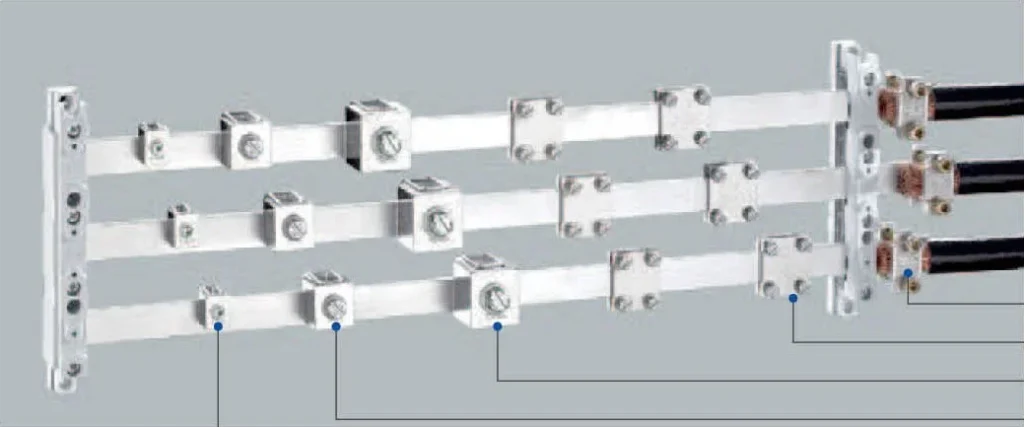
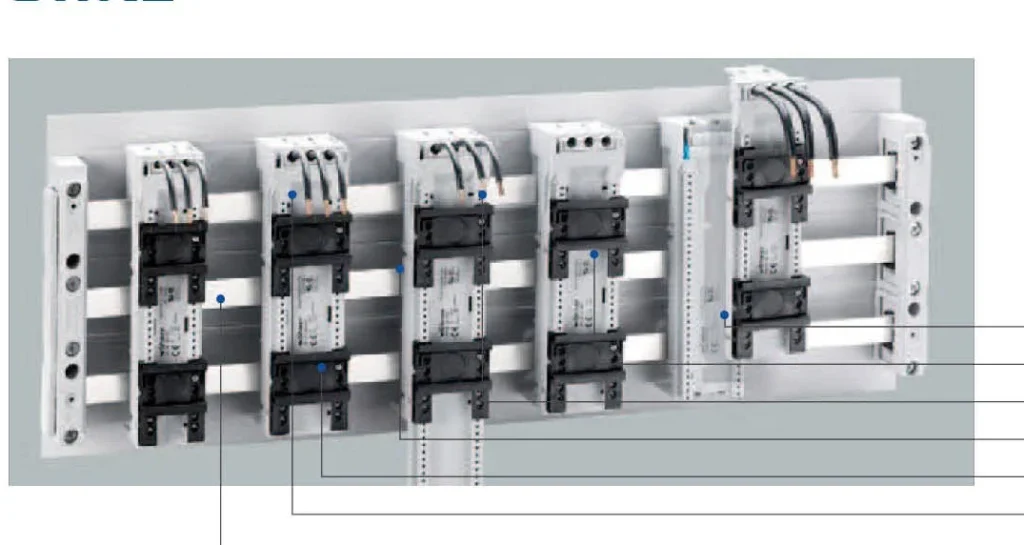
Connection terminals are the interface between the copper bar and the cable. The CWNE range covers screw terminals for single cables and plate clamps where two cables land on the same point, all mounted directly on the bar without removing it.
Range
| Parameter | Range / value |
|---|---|
| Screw terminals | M5 x 8 (360 A), M5 x 12, M6 x 12, M8 x 12, M10 x 10 (630 A) |
| Clamp terminals | Plate clamps for 2T, 3T and TCC busbars |
| Conductor range | 0.75 mm² (18 AWG) to 300 mm² (600 MCM), copper |
| Cables per terminal | One cable per terminal as standard; plate clamps accept two |
| Tightening torque | Stated per terminal, tolerance ±20 % |
| Current transformers | Bar-mounted CTs, class 1, 5 A secondary, 6.3 x 0.8 mm flat terminals to DIN 46 244-A |
Installation
Remove oxide from the conductor before termination and apply contact protection; the conductor must be inserted far enough that the clamp closes on bare copper, with the insulation kept outside the terminal. Where two cables share a point, use a plate clamp rather than stacking lugs. Retighten after the first thermal cycle and at the recommended inspection interval.
Selection notes
- Match the terminal current rating to the outgoing circuit, not to the busbar rating.
- Check the conductor range: a terminal that is too large for the cable reduces the contact area and the current capacity.
- Use a torque wrench — the stated torque must be held to ±20 % for the connection to stay stable.
Ordering information
State the busbar profile, the cable cross-section and number of cables per point, and the required terminal current.
FAQ
What cable sizes can be terminated on the busbar?
Copper conductors from 0.75 mm² (18 AWG) to 300 mm² (600 MCM), depending on the terminal selected.
Can two cables be connected at one point?
Yes, using a plate clamp. Stacking cable lugs under a single screw is not recommended.
Do you supply current transformers for the busbar?
Yes. Bar-mounted current transformers with class 1 accuracy, 5 A secondary and 6.3 x 0.8 mm flat terminals to DIN 46 244-A.
Why does the tightening torque matter?
The contact resistance and the thermal behaviour of the joint depend on the contact pressure. The stated torque must be held to plus or minus 20 percent, and the joint rechecked after the first thermal cycle.
Request Quote
Tell us your specifications, quantity, or application scenario and we will reply with a tailored quote.